DIAL: Programmable Promoter Editing to Generate Defined, Heritable Setpoints of Gene Expression
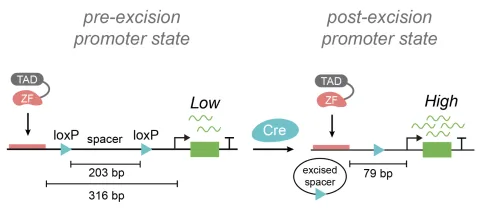
This technology is a programmable synthetic promoter system that enables precise control and editing of setpoints of transgene expression. To set different levels of expression, the system uses recombinases to excise engineered spacers between transcription factor binding sites and a core promoter. By bringing these elements closer together, RNA levels of the transgene increase, shifting the setpoint of transgene expression higher. Unlike conventional inducible systems—which generate bimodal "ON/OFF" populations that resist intermediate expression states—DIAL converts temporary recombinase inputs into uniform, heritable promoter states that maintain defined setpoints over time.
Researchers
-
dial: programmable promoter editing to generate defined, heritable setpoints of gene expression
Patent Cooperation Treaty | Published application
Technology
The technology begins by introducing an engineered promoter upstream of a transgene, with transcription factor binding sites separated from the core promoter by excisable spacers. A synthetic transcription factor binds to designated sites within the promoter, while an intervening DNA spacer limits expression by separating these binding sites from the core promoter. Upon recombinase activation, which can be controlled via small-molecules or modRNA, the recombination system excises spacer segments. This excision brings the trans-activator binding sites closer to the core promoter, increasing transcriptional activation and shifting expression to a higher level. The system can be further modulated by incorporating multiple distinct transcription factor binding sites, allowing different synthetic transcription factors to alter expression levels modularly and in combination.
Problem Addressed
Existing gene regulation technologies often lack the precision needed to stably control dosage-sensitive transgenes at different setpoints. Conventional inducible systems require continuous supply of small molecules to induce expression and can also produce bimodal distributions in which high- and low-expressing cell populations coexist, without substantially changing the expression level of either population. DIAL generates unimodal distributions of varying mean expression levels from a single genetic construct, enabling fine-scale expression changes that remain robust to variations in transcription-factor levels above a threshold. By layering orthogonal recombination sites with different spacer lengths, researchers can achieve multiple tunable, stable setpoints within a single construct.
Advantages
Generates multiple precise, unimodal levels of transgene expression from a single engineered promoter
Converts temporary molecular inputs into heritable expression states that persist across cell divisions
Maintains consistent expression despite variations in transcription-factor levels above a threshold
Can be delivered with viral vectors to control expression levels in primary cells
Publications
Kabaria, Sneha R., Yunbeen Bae, Mary E. Ehmann, Brittany A. Lende-Dorn, Adam M. Beitz, Emma L. Peterman, et al. “Programmable Promoter Editing for Precise Control of Transgene Expression.” Nature Biotechnology (2025). https://doi.org/10.1038/s41587-025-02854-y
License this technology
Interested in this technology? Connect with our experienced licensing team to initiate the process.
Sign up for technology updates
Sign up now to receive the latest updates on cutting-edge technologies and innovations.