An Electrokinetic-based High-Throughput Concentrator for Cells, Bioparticles, and Molecules
This technology is related to cases #26458, #22511, #20884, #18940, #15955, #15591, #14462 as well as #18989, #16927
This invention discloses an electrokinetic-based device and methods to concentrate biological particles from fluids. The technology can be used for the detection of low abundance biomolecules such as bacteria and viruses in fluid—for example, enabling the early diagnosis of sepsis from a blood sample. By integrating a multi-scale porous ion exchange membrane (MP-IEM), this technology utilizes coupled electrophoretic and drag forces to concentrate biological particles in a fast and high-throughput manner without the clogging issues associated with conventional membrane-based filters. Additionally, it addresses the need for an electrokinetic concentrator that is scalable and can be utilized under high flux.
Researchers
-
electrokinetic-based concentrator device and method
Patent Cooperation Treaty | Published application -
electrokinetic-based concentrator device and method
United States of America | Granted | 12,181,393
Figures
Technology
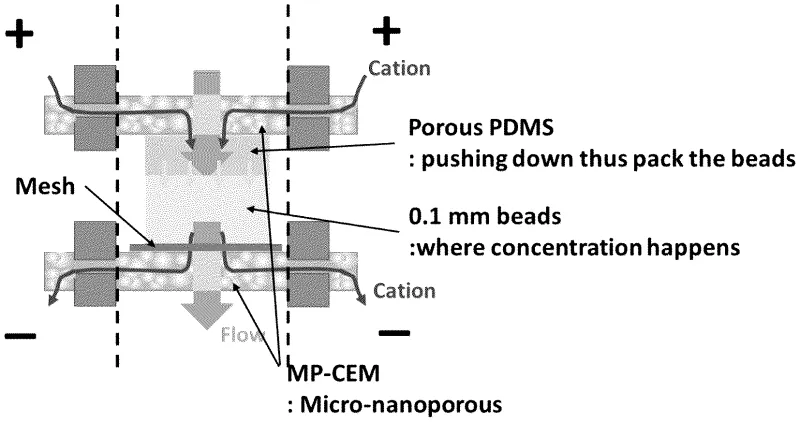
As the fluid sample enters the electrokinetic concentrator device, it flows into the main chamber, which is positioned between anodic and cathodic chambers that apply an electric field across a main chamber. The electric field drives the flow of the sample fluid through the chamber and across a first cation‑exchange membrane (CEM). The first CEM generates an ion-depleted region on its surface, concentrating the intensive electric field and generating an electrokinetic force. At the downstream end of the main chamber, a multi-scale porous cation‑exchange membrane (MP‑CEM) integrates both nonporous and microporous structures. The micropores allow fluid transport across the membrane, generating a drag force that opposes the electrophoretic force. A microporous structure (e.g., cotton fibers or packed beads) is positioned slightly above the MP-CEM, providing a stable region where the opposing forces precisely balance. The particles accumulate in this microporous structure, resulting in a concentrated sample that can be analyzed using PCR, rapid test strips, or immunoassay-based techniques.
Problem Addressed
Conventional filtration methods that rely on size-based separation suffer from clogging, high pressure requirements, and low throughput. Increasing filter surface area has been found to mitigate clogging but reduces concentration efficacy. Electrokinetic force-based separation techniques avoid physical clogging but have been limited to the microfluidic scale. To address the need for an electrokinetic concentrator that is scalable, supports high flux, and capable of detecting low-abundance biomolecules, the inventors developed the MP-IEM, which features nanopores for ion transport and micropores allowing fluid transport. The resulting system uses electrophoretic forces coupled with drag force to concentrate biological molecules in a fast and high-throughput manner without the clogging issues associated with conventional filters.
Advantages
- Does not require a physical filter, avoiding membrane clogging issues
- Enables separation and concentration of various biomolecules from a buffer or sample fluid with a maximum concentration factor of over 106
- Enables the meaningful detection of bacteria, viruses, or heavy metal ions even with low-sensitivity and low-cost sensors such as paper strip test
- Broad applications, including:
- Concentration of bacteria from blood samples (ex. E. Coli, Streptococcus pneumoniae, Staphylococcus aureus)
- Detection of viruses from blood samples (ex. Influenza, RSV, Coronavirus)
- Detection of biomolecules from cerebrospinal fluid (CSF) sample for disease diagnosis (ex. meningitis, tuberculosis)
- Detection of bacterial contamination in food
- Detection of waterborne pathogens
- Detection of contamination in biomanufacturing processes
License this technology
Interested in this technology? Connect with our experienced licensing team to initiate the process.
Sign up for technology updates
Sign up now to receive the latest updates on cutting-edge technologies and innovations.