Constriction-Minimizing Microfluidic Devices Enabling Co-Culture in Engineered Hydrogels
This case is related to technology #22618.
This invention discloses a microfluidic cell culture device ("GelChip") that enables 3D co-culturing of cells with engineered biomaterial scaffolding. The device minimizes constriction induced by scaffold swelling through increased heights in the cell culture chambers and connecting channels. Additionally, its open-top design allows improved access for experimental manipulation. By overcoming the challenges associated with hydrogel swelling in conventional microfluidic 3D cell culture devices, this invention enables the creation of complex tissue models with key features of 3D cell culture including cell-cell interactions, cell migration, and vascularization.
Researchers
-
constriction-minimizing microfluidic devices
United States of America | Pending -
constriction-minimizing microfluidic devices
European Patent Convention | Pending
Figures
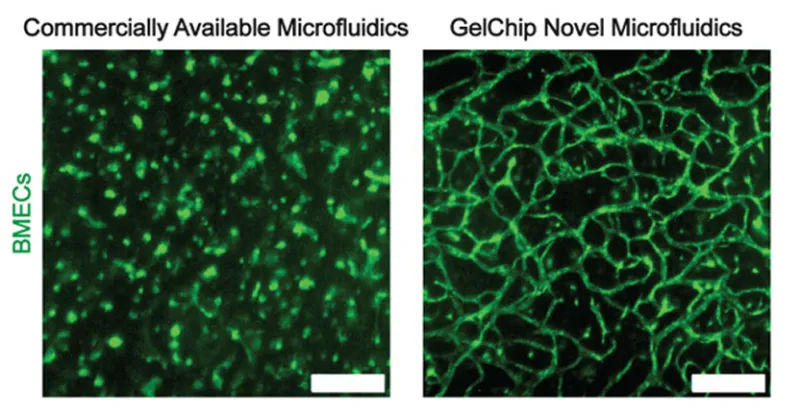
Comparison of the formation of miBRAIN 3D endothelial cell networks cultured in a conventional microfluidic device in an engineered hydrogel (left) versus in a constriction-minimizing GelChip microfluidic design (right)
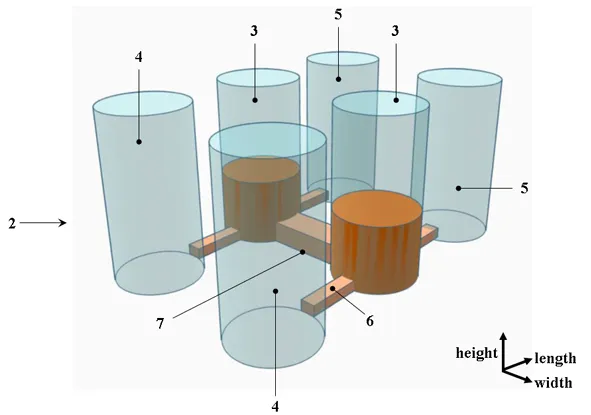
Representative microfluidic network configuration comprising two interconnected cell culture chambers with inlet and outlet chambers. Device dimensions can be tuned in height, width, and length to support scaffold swelling, perfusion, and tailoring to specific biological applications.
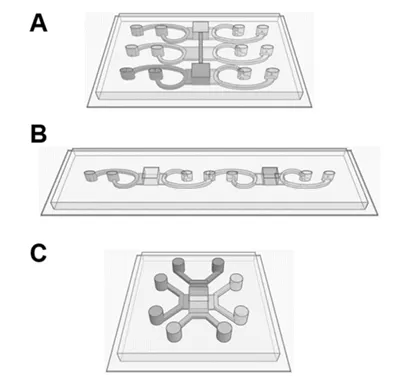
Representative 2Region-, Peripheral-, and DualNetwork-GelChip configurations with applications in modeling tissue-tissue interactions, blood-borne signaling, and cellular networks with independently controlled inputs.
Technology
The device comprises open-top inlet chambers, outlet chambers, cell culture chambers, and connecting channels, all connected in a microfluidic network. Cells are introduced into the chambers within an engineered hydrogel scaffolding substance. The dimensions of the cell culture chambers, propagation channels, and inlet and outlet channels are designed with increased height to support the swelling of the hydrogel scaffold while avoiding additional strain on the substance and minimizing cell compression. In this way, the device supports the formation of complex 3D cell co-cultures, and the interconnected chambers further enable perfusion, cell-cell communication, and cell migration across tissue regions. The configuration of the microfluidic network can be modulated for the biological question being addressed, such as modeling multiple interconnected tissue regions or signaling circuit interactions.
Problem Addressed
Microfluidic 3D cell culture devices support physiologically relevant tissue-like architecture, making them valuable tools for disease modeling and therapeutic discovery. Simultaneously, new engineered biomaterials such as synthetic hydrogels offer improved capabilities in replicating human tissue-like microenvironments and features of pathogenesis. However, there has been limited success in combining these engineered materials with microfluidic device platforms due to their characteristic swelling properties. In conventional microfluidic devices, hydrogel swelling in confined channels creates pressure-induced strain that compresses embedded cells, disrupting tissue formation and often resulting in cell injury or cell death. This invention is a constriction-minimizing microfluidic 3D cell culture device designed to support the swelling of scaffolding material without causing damage to the cultured cells.
Advantages
- Accommodates hydrogel swelling while minimizing cell compression and disruption of tissue formation
- Enables continuous perfusion throughout the device
- Open-top design provides easy access to cells, scaffold, and culture fluid, allowing the delivery of agents such as drugs, cells, and dyes into specific chambers
- Supports complex 3D co-cultures that require accommodation for hydrogel swelling
- Enables compatibility with engineered hydrogels for 3D cell culture, supporting potential applications including vascular network formation, vessel perfusion, and directional cell migration
- Configuration of the microfluidic network can be designed to address specific biological questions
License this technology
Interested in this technology? Connect with our experienced licensing team to initiate the process.
Sign up for technology updates
Sign up now to receive the latest updates on cutting-edge technologies and innovations.