Regenerative Bioreactor via Ion Concentration Polarization Waste Removal
This invention discloses a microfluidic separation device that enables reuse of spent cell-culture media in perfusion bioreactors by selectively removing critical waste products while retaining valuable nutrients. This technology uses an electrokinetic separation approach based on ion concentration polarization (ICP) to remove charged particles such as ammonium and lactate, while retaining neutral nutrients such as glucose and most amino acids at a normal pH. By enabling recycling of spent cell-culture media, this invention reduces raw material input costs and wastewater generation, improving process mass intensity and the environmental performance of perfusion-based biologic drug manufacturing.
Researchers
-
regenerative bioreactor via ion concentration polarization waste removal
Patent Cooperation Treaty | Published application
Figures
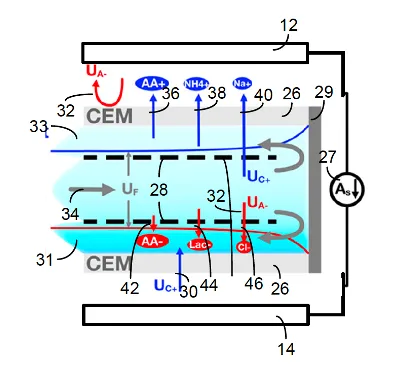
Illustration depicting the transport of waste products, metabolites, and electrolytes during the ICP separation process in one layer of the device.
Technology
The ion-concentration-polarization device is comprised of alternating layers of cation exchange membranes and millifluidic spacer layers arranged in a stacked configuration. Each spacer layer contains a fluidic channel sandwiched between semi-permeable ion-selective membranes that allow ion transport while restricting bulk fluid flow. An electric field is applied across the device, as the spent cell-culture medium is introduced and flows through the channels in a return-flow configuration. As fluid flows through each layer, charged waste species migrate according to the applied field: cationic waste products (e.g., ammonium) are driven up through the internal semi-permeable membrane and the top cation-exchange membrane, while anionic species (e.g., lactate) are drawn down through the bottom internal membrane. The system generates a waste stream flowing between the bottom internal membrane and the lower cation exchange membrane, capturing both the positive and negatively charged species. The harvest stream flows between the internal membrane and the top cation exchange membrane, capturing the cell culture media depleted of charged species.
Problem Addressed
Monoclonal antibodies (mAbs) are of central importance to modern therapeutics and constitute many of the pharmaceutical industry’s highest-revenue drugs. Although batch reactors remain standard for mAb manufacturing, perfusion bioreactors offer advantages including increased volumetric productivity, more stable culture conditions, and the potential for continuous antibody harvesting over extended production periods. However, perfusion bioreactors generate large volumes of spent media, which is typically discarded despite being only partially depleted of nutrients and still containing expensive growth factors. Existing recycling methods, such as filtration, are not adequate for removing key metabolic waste products such as ammonia (NH4+) and lactate, which can inhibit growth and productivity. To enable effective reuse of spent cell-culture media, the inventors developed methods and systems that selectively remove these charged waste metabolites while retaining leftover nutrients, preventing the accumulation of inhibitory molecules across recycling cycles.
Advantages
- Enables continuous waste removal and integration without modifying any part of the bioreactor setup, as the device is placed directly into the waste stream that is typically discarded
- Demonstrated ability to regenerate and reuse up to 75% of spent cell-culture media without adversely affecting cell viability
- Resulting water process mass intensity improved by up to 33%
- ICP separation systems have been scaled to support large-volume processing, supporting feasibility for manufacturing-scale bioreactors (e.g., 50L perfusion culture of CHO cells)
License this technology
Interested in this technology? Connect with our experienced licensing team to initiate the process.
Sign up for technology updates
Sign up now to receive the latest updates on cutting-edge technologies and innovations.