Recombinant Transmembrane Domain-Deficient STING as Biomimetic Protein Carrier for cGAMP Enhanced Cancer Immunotherapy
This technology is a STINGΔTM–nanobody fusion-protein complex for treating solid tumors and protecting against cancer recurrence, comprising transmembrane domain-deficient STING (STINGΔTM), fused to a nanobody capable of binding to a cancer cell or tumor extracellular matrices, and the STING agonist cGAMP. Within the tumor microenvironment, cGAMP-activated STINGΔTM initiates and coordinates innate and adaptive immune responses that can convert the treated tumor into an in-situ vaccine, while the nanobody blocks checkpoint signaling that could suppress the resulting antitumor response. By integrating these complementary mechanisms into one platform, the fusion treatment produced stronger antitumor activity in preclinical studies than either function alone and, in one model, outperformed co-administered STING therapy and checkpoint antibodies.
Researchers
-
engineering immune checkpoint blockade nanobody-sting delta-tm fusion protein as a versatile treatment for solid tumor cancers
United States of America | Published application
Figures
Technology
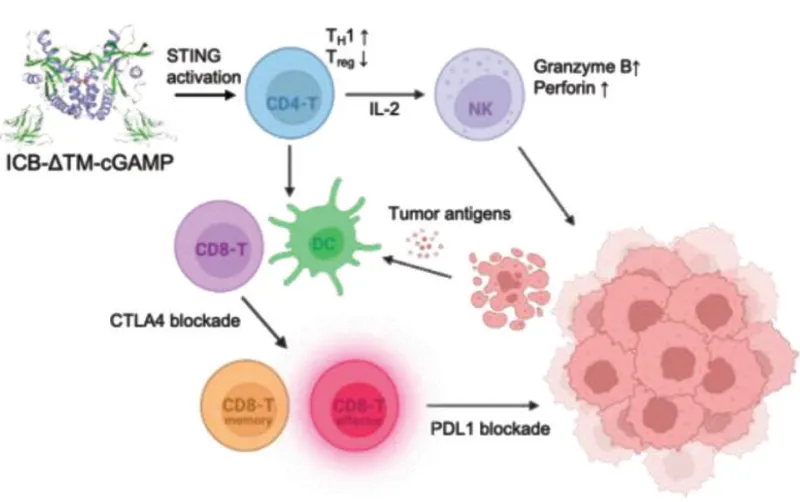
The nanobody–STINGΔTM fusion protein is expressed and purified from E. coli, then combined with the STING agonist cGAMP to form the therapeutic complex. Following intratumoral injection, nanobody binding enhances localization within the tumor microenvironment, and/or blocking inhibitory checkpoint signaling. After cellular uptake, cGAMP-bound STINGΔTM activates inflammatory signaling and promotes polarization of CD4+ T cells toward a TH1 phenotype. These TH1-oriented CD4+ T cells help coordinate early NK-cell cytotoxicity and support dendritic-cell priming of tumor-reactive CD8+ T cells, which contribute to later tumor elimination. As tumor cells are killed, they release a broad range of antigens that can be presented by dendritic cells to expand tumor-specific T cells and generate immune memory, helping convert the treated tumor into an in-situ vaccine.
Problem Addressed
Harnessing the patient’s immune system is one of the most promising strategies for achieving durable cancer control, but current immunotherapies work best in tumors with favorable immune features and often fail to activate and coordinate the full range of immune cells needed for an effective response. One potential solution is to combine immune checkpoint inhibitors with immune-activating treatments such as STING agonists; however, STING agonists may cause harmful inflammation when delivered systemically and may be less effective in patients with reduced-function endogenous STING variants. By combining the previously developed STINGΔTM–cGAMP immune-activating complex with checkpoint-blocking nanobodies, this technology coordinates a broader range of immune-cell populations in preclinical studies and may help address both tumor-specific immune resistance and patient-specific limitations in STING function.
Advantages
- Broad efficacy across distinct solid-tumor models: In preclinical models, treatment with a mixture of anti-PD-L1–STINGΔTM and anti-CTLA-4–STINGΔTM fusion proteins complexed with cGAMP reduced tumor growth and improved survival in both the immune-responsive MC38 colon carcinoma model and the less responsive YUMM1.7 melanoma model.
- Durable protection against tumor rechallenge: In the reported MC38 and YUMM1.7 studies, all mice cured with the nanobody–STINGΔTM–cGAMP treatments rejected a second inoculation with the same tumor type, supporting the development of lasting, tumor-specific immune memory.
- Coordination of multiple immune-cell populations: Immune-cell depletion studies showed that CD4+ and CD8+ T cells were required for treatment efficacy, with TH1-polarized CD4+ T cells helping to coordinate early NK-cell activity and later CD8+ T-cell-mediated tumor control.
- Improved performance compared with co-administered therapies: In the YUMM1.7 model, the fused nanobody–STINGΔTM-cGAMP platform resulted in smaller tumors, greater survival, and stronger protection against rechallenge than STINGΔTM-cGAMP co-administered with both anti-PD-L1 and anti-CTLA-4 monoclonal antibodies.
- Localized delivery: At 24 hours after intratumoral injection, the complex was detected primarily within the tumor and tumor-draining lymph node, supporting localized immune activation and the potential to reduce systemic exposure.
Publications
He, Yanpu, et al. “STING Protein-Based In Situ Vaccine Synergizes CD4+ T, CD8+ T, and NK Cells for Tumor Eradication.” Advanced Healthcare Materials 12, no. 24 (2023): 2300688.
License this technology
Interested in this technology? Connect with our experienced licensing team to initiate the process.
Sign up for technology updates
Sign up now to receive the latest updates on cutting-edge technologies and innovations.