Purification of Ultra-High Saline and Contaminated Water by Multi-Stage Ion Concentration Polarization (ICP) Desalination
This invention discloses a method of purifying or concentrating ultra-high salinity and contaminated water using multi-stage ion concentration polarization (ICP). This technology uses a trifurcated flow channel and a serialized, multi-stage configuration to enable low-cost and low-energy treatment of water with high salt concentrations. By enabling simultaneous particle removal during desalination, this technology eliminates the multiple pretreatment steps typically required to remove suspended solids such as oils, organics, and biological contaminants. As a result, it addresses major limitations of existing water‑purification technologies and significantly reduces overall energy and equipment costs.
Researchers
-
purification of ultra-high saline and contaminated water by multi-stage ion concentration polarization (icp) desalination
United States of America | Granted | 10,252,924
Technology
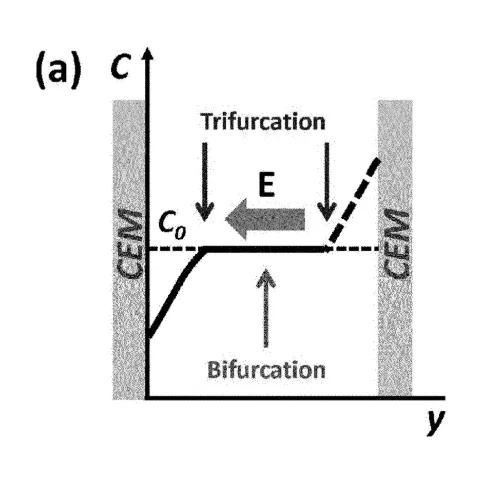
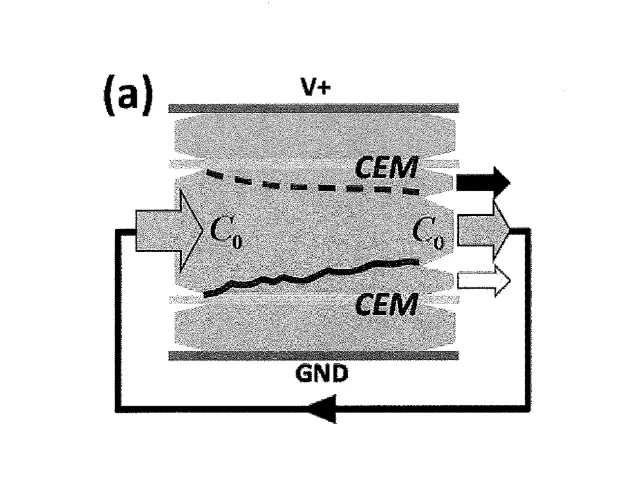
A channel of the ICP device comprises two juxtaposed similar ion exchange membranes under an applied electric field. The electric field is generated by an electrode and a ground located external and parallel to the channel, each forming a secondary channel with its adjacent membrane. When high-salinity water flows through, the configuration results in the creation of an ion depletion zone, an intermediate zone, and an ion enrichment zone within each channel (Figure 1). The channel outlet is trifurcated, dividing the flow into three output streams: dilute (salt-depleted), intermediate (minimal salinity change), and concentrate (salt-enriched). Additionally, due to electro migration and electro-convection forces, negatively charged particles—including red blood cells, crude oil emulsions, bio-agents (e.g., Escherichia coli, Salmonella, and Pseudomonas), sludge, and colloidal particles—are excluded from the depletion stream. Thus, the system achieves simultaneous desalination and particle removal. In a multi-stage configuration, the dilute and concentrate streams are extracted after each stage, while the intermediate stream is delivered to the next stage as feed water (Figure 2). This serialized operation minimizes total membrane area and energy requirements, especially for highly saline solutions, since higher salt removal in a single stage requires greater membrane area and higher power consumption.
Problem Addressed
There is an increasing global demand for cost-effective methods to purify contaminated ground water. In particular, the growing development of shale gas sources has created a need for technologies capable of treating water produced as flowback, which is often highly contaminated with suspended solids as well as salt levels often 1-5 times higher than seawater. While reverse osmosis is the dominant technology in the non-thermal desalination market, it is not economically viable for treating ultra-saline water. As a result, the shale development industry typically employs thermal desalination, which is energy-intensive. Current desalination methods remain costly due to the multiple pretreatment steps necessary to remove suspended solids, high energy requirements, and expensive equipment. This invention overcomes these limitations by enabling simultaneous removal of salt particles and suspended contaminants. The trifurcated outlet and multi-stage design significantly improves membrane efficiency, reducing both the required membrane area and total power consumption. The combined advantages of cost-effective ultra-saline water purification, coupled with the ability to simultaneously remove suspended solids, position ICP to emerge as a preferred technology in the shale development industry.
Advantages
- Economical for treating high-salinity contaminated water, such as flowback from shale gas development
- Simultaneous removal of salt ions, colloidal pollutants, and charged bio-agent particles
- Lower membrane area and energy requirements compared to previous ICP electrodialysis devices
License this technology
Interested in this technology? Connect with our experienced licensing team to initiate the process.
Sign up for technology updates
Sign up now to receive the latest updates on cutting-edge technologies and innovations.