Ion Concentration Polarization - Electrocoagulation Hybrid System for Water Treatment
This invention discloses a method of purifying or concentrating a water stream, achieving both pre-treatment and desalination within the same device. This technology combines ion concentration polarization (ICP) with electrocoagulation (EC) using shared electrodes to separate both ionic species and particles from a purified water stream. By enabling simultaneous desalination and particle removal, this invention overcomes key limitations of existing water purification technologies such as high energy requirements and pre-treatment steps to prevent membrane fouling.
Researchers
-
ion concentration polarization-electrocoagulation hybrid water treatment system
United States of America | Granted | 10,099,945
Technology
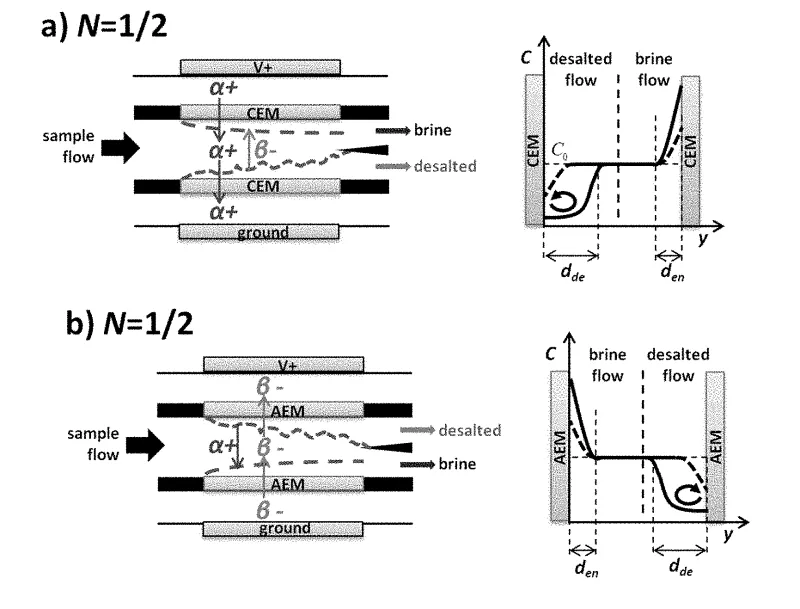
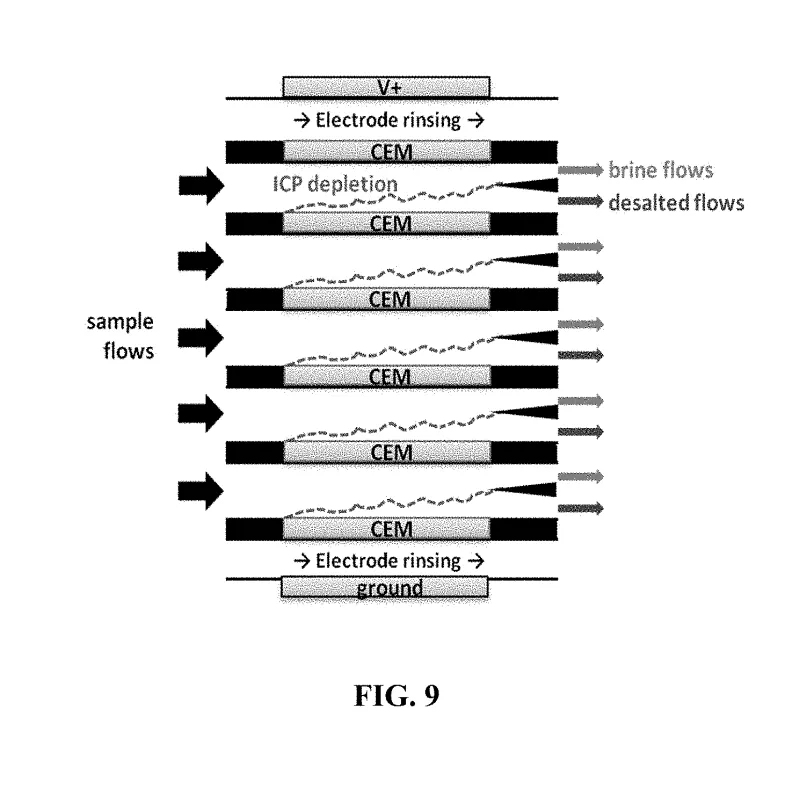
The ICP-EC device uses two similar ion-exchange membranes under an applied electric field to create an ion depletion zone and an ion enrichment zone within each channel. For example, when using cation exchange membranes (CEMs), cations are selectively transferred through the CEMs, causing the relocation of anions in order to achieve electro-neutrality. This results in an ion depletion zone with a reduced concentration of ions—including salt ions and charged agents such as proteins and bacteria—and an ion enrichment zone with an increased concentration of ions. Additionally, the electrolysis of the sacrificial metal anode releases metal ions that act as a coagulants, destabilizing colloidal particles from the feed stream. These particles are repelled in the ICP depletion zone. The channel is bifurcated at the end, allowing the flow with reduced ionic species from the depletion zone to be separated into a purified water stream, while the flow with concentrated ionic species from the enrichment zone is separated into a concentrated stream. This method can also be performed with two anion exchange membranes, by relocating cations, where the locations of the desalted/brine flows are converted. By stacking the unit platforms in parallel, the system can be scaled up for larger flow rates.
Problem Addressed
The increasing global health threat posed by the pollution of drinking water is driving interest in scalable and inexpensive technologies for water desalination, purification, and monitoring. Many desalination systems require either a very high energy input (e.g., thermal evaporation technologies) or complicated pre-treatment steps to remove potential foulants (e.g., membrane-based technologies). Reverse osmosis (RO), the current leading technology for desalination, is highly sensitive to membrane fouling and requires extensive pre-treatment to remove potential foulants, such as suspended solids or bacteria. Another desalination technology is electrodialysis (ED), which removes salt, but not nonionic particles. In both RO and ED, particle removal needs to be done prior to desalination. By combining ICP and EC, the inventors developed a single electrochemical system that enables simultaneous pre-treatment and desalination, reducing membrane fouling as well as voltage drop and energy consumption.
Advantages
Simultaneous removal of salt ions, colloidal pollutant particles and charged bio-agents
Offers flexibility to treat various types of wastewater, such as:
brackish groundwater
household water containing bacteria or other biological contaminants
murky water from various suspended solids and/or industrial heavy metal contaminants
Requires lower energy than conventional desalination systems and avoids complex pre-treatment steps
Potential for scale-up and high flow rates by stacking the unit system or converting from existing ED platforms
Operates without a high-pressure system, making it suitable for small-scale localized water treatment
Has demonstrated removal of salt, fluorescent microparticles, silica, and E. coli bacteria
License this technology
Interested in this technology? Connect with our experienced licensing team to initiate the process.
Sign up for technology updates
Sign up now to receive the latest updates on cutting-edge technologies and innovations.